Looking into Our Earth’s History from the Microscale
Serpentinite and Its Minerals


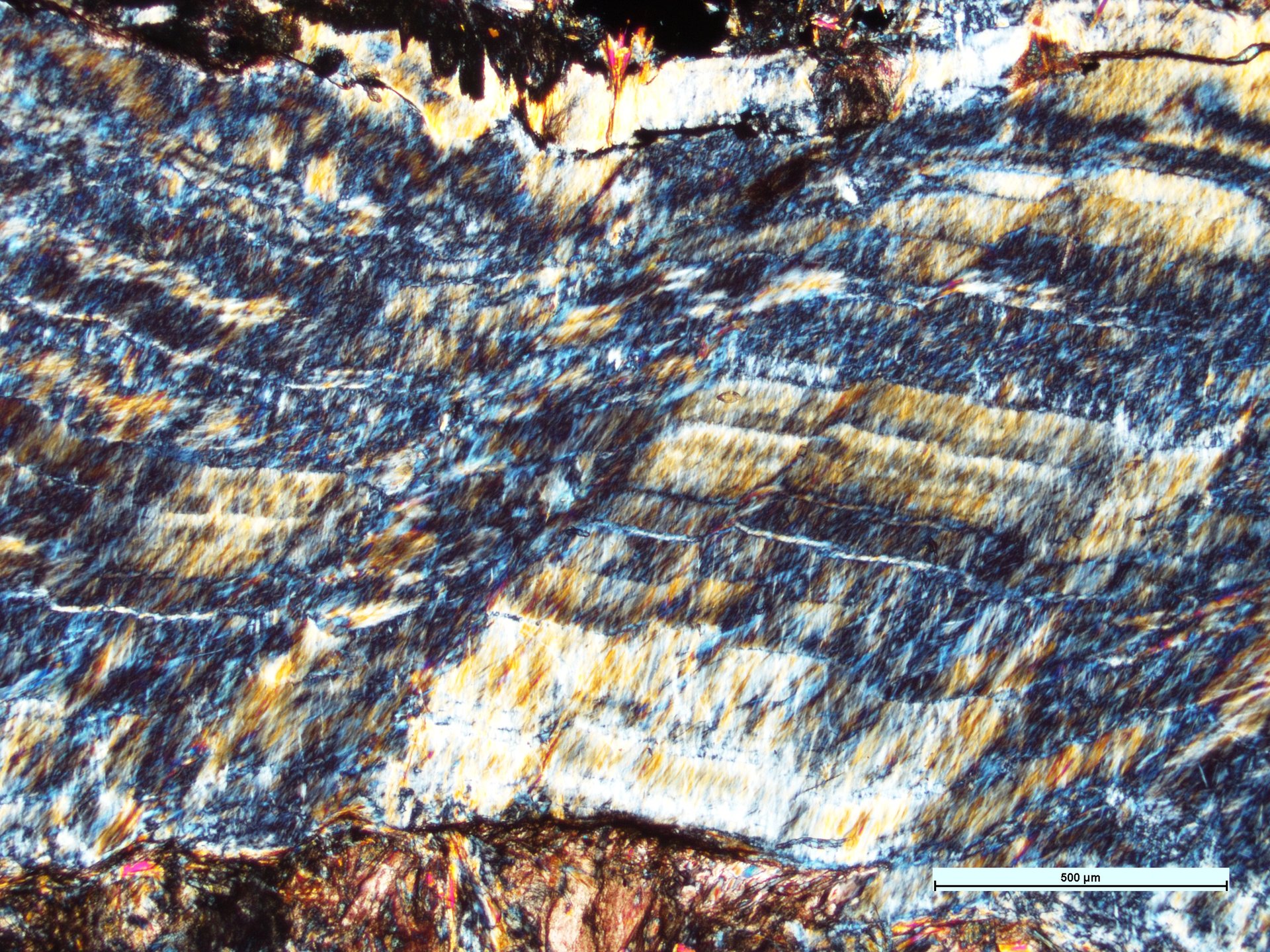
Cross-polarized light (XPL) photomicrograph of serpentinite sample DK023A from the Tsunkuanshan area, Yuli belt, eastern Taiwan.
Serpentine (Mg,Fe)₃Si₂O₅(OH)₄, a hydrous magnesium phyllosilicate group comprising three main polymorphs — antigorite, lizardite, and chrysotile — sharing near-identical chemistry but differing in how their tetrahedral-octahedral layers curve and stack (planar in lizardite, wavy in antigorite, rolled into tubes in chrysotile). Antigorite formed under higher metamorphic temperature conditions than the other two (lizardite and chrysotile).
This photomicrograph shows typical interpenetrating or flaky antigorite (Atg) intergrown with brucite (Brc) and magnetite (Mag). This feature might represent that antigorite, brucite, and magnetite were in equilibrium during their formation.


Plane-polarized light (PPL) photomicrograph showing chromian spinel (Cr-spl) in serpentinite from the Fengtien area, Yuli belt, eastern Taiwan.
Chromian spinel (Cr-spinel), general formula (Mg,Fe²⁺)(Cr,Al,Fe³⁺)₂O₄, is an accessory oxide mineral of the spinel group found in ultramafic and mafic rocks — peridotites, chromitites, and layered intrusions. In hand sample it's opaque and appears black to brownish-black; only in thin section, under transmitted light, does it show its true colors — ranging from yellow through orange to deep red as iron content increases. Cr-spinel is notably resistant to alteration: in serpentinized peridotite (serpentinite), where olivine and pyroxene have largely broken down to serpentine, unaltered spinel cores often survive and preserve their original igneous chemistry, even as their rims are modified to ferritchromite or magnetite. Because its composition (Cr#, Mg#, Fe³⁺) shifts systematically with the chemistry and oxidation state of its parent magma, geologists use it as a sensitive petrogenetic indicator to trace magma source, degree of partial melting, and tectonic setting.


Cross-polarized light (XPL) photomicrograph of serpentinite from the Yuli belt, eastern Taiwan.
Olivine, (Mg,Fe)₂SiO₄, has forsterite (Mg₂SiO₄) and fayalite (Fe₂SiO₄) as its end-members; it becomes the stable Mg-Fe silicate phase at metamorphic grades higher than those at which serpentine is stable.
This photomicrograph shows a bastite texture of serpentine (Srp) after pyroxene that is rimmed by metamorphic olivine (Ol) that grew during increasing metamorphic grade, replacing serpentine with olivine. In this sample, the metamorphic olivine has a forsterite content of Fo95–99. This bastite texture rimmed by metamorphic olivine indicates a harzburgitic protolith composition that was serpentinized and deserpentinized during metamorphism.
Contacts
dekadewangga@gms.ndhu.edu.tw or dekadewangga@gmail.com
Social media
@dekadewangga
Department of Natural Resources and Environmental Studies, National Dong Hwa University. No. 1, Sec. 2, Da Hsueh Rd., Shoufeng, Hualien 97401, Taiwan, R.O.C.